Light.
When you read that word, a few things probably flash through your mind: Bright. Shiny. Lively. Warm. It’s not something we think much about — because it’s always just… there.
But when you take a closer look at what light actually is, it makes you wonder: Could it be more?
Short answer? Yes. Long answer? This is where the fun begins.
I’m the kind of person who gets curious about things — sometimes more than I probably should, or even could.
One of those moments hit me while I was standing on the balcony of my high-rise apartment, watching rain — or maybe sleet — falling in the darkness.
You might ask: “How could you see rain or sleet in the dark?”
And I’d say: You can. You actually can.
Even in darkness, there’s usually just enough light — a streetlamp, a glow from another building — that a few stray photons bounce off those falling droplets and reach your eyes.
And that’s all your brain needs.
Our vision doesn’t work because we see objects directly — it works because light reflects, sneaks into our eyes, and gives our brains the raw material to build reality.
So when I watched those tiny streaks in the dark sky — shimmering, fading, blinking in and out — I realized something:
Light isn’t just what lets us see the world. It’s what builds the world inside our minds.
The magic behind light
Let’s zoom in on that light.
Light is nothing but a beam or glow made up of something called a photon. But don’t imagine a photon as a tiny speck of something — imagine a little ball of energy: massless, weightless, and incredibly fast.
These photons aren’t made of matter like us, or anything we can touch. They’re pure energy, always on the move, flying at what we call the speed of light — about 299,792,458 meters per second.
Sounds like magic? Maybe it is.
Here’s a thought experiment
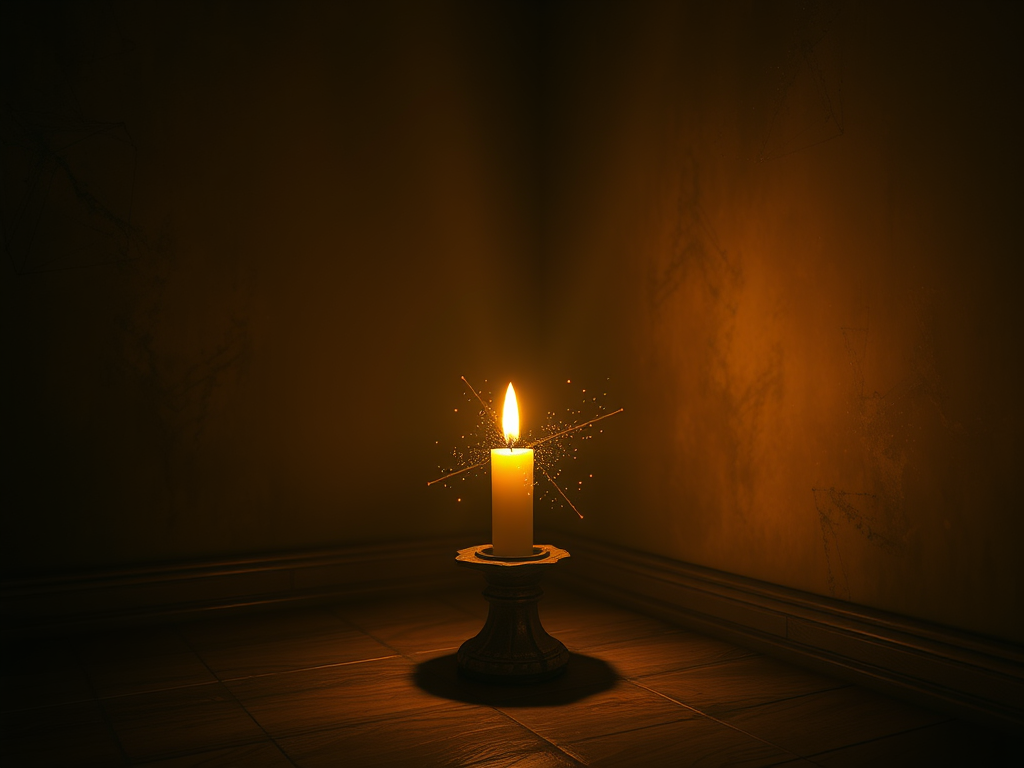
Picture a dark room with a single candle.
You strike a match, light the wick, and the tiny flame begins to glow. Feels cozy, right? But behind the scenes?
The heat from the flame excites atoms, which start releasing photons — tiny bursts of energy. Those photons shoot out in every direction, bouncing off the walls, the floor, the ceiling, and you.
Some of them make it all the way to your eyes. There, special cells catch them, convert their energy into electric signals, and send those signals to your brain.
Your brain does the rest.
It paints the flame, the shadows, the golden hue in the room.
You’re not seeing the candle.
You’re seeing the photons your brain managed to catch.
And if there were no walls, no objects, no eyes? Those photons would just keep flying through space — forever unseen, untouched, and unclaimed.
Here’s where light really messes with you
You’d think photons — little packets of energy — would fly like bullets. Straight. Predictable. Clean.
But they don’t.
Sometimes, they act like particles.
Sometimes, they act like waves.
And sometimes — they act like both at once.
This is called wave-particle duality, and it’s one of the strangest truths in all of physics.
The experiment that broke reality
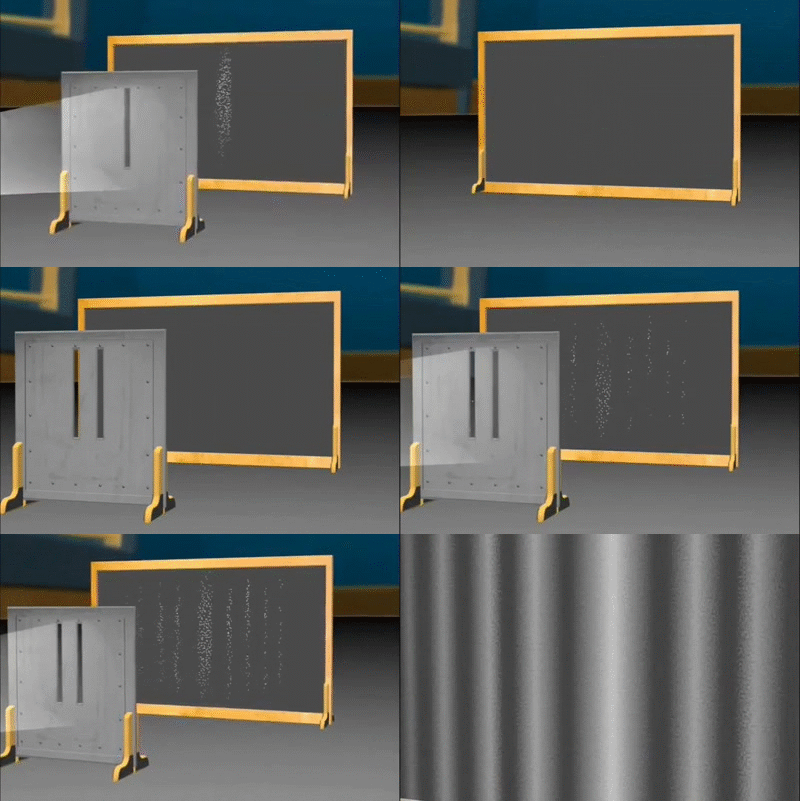
This was proven by the now-famous Double-Slit Experiment — the one that made physicists question everything.
Here’s how it goes:
- You shoot photons at a barrier with two narrow slits.
- If they act like particles, you’d expect each one to go through either the left slit or the right.
- But they don’t.
Instead, they create an interference pattern on the far wall — the kind of pattern you’d expect from waves, not particles.
Then comes the twist:
Add a detector to measure which slit each photon goes through? Suddenly the interference pattern disappears. They start acting like particles again.
The act of observing changes what light does.
It’s like light says, “Oh, you’re watching? Okay, I’ll behave like a particle now.”
Which begs the question:
Is reality waiting for us to look before it decides what to be?
And just when you thought it couldn’t get weirder…
We already know photons move incredibly fast — at the speed of light.
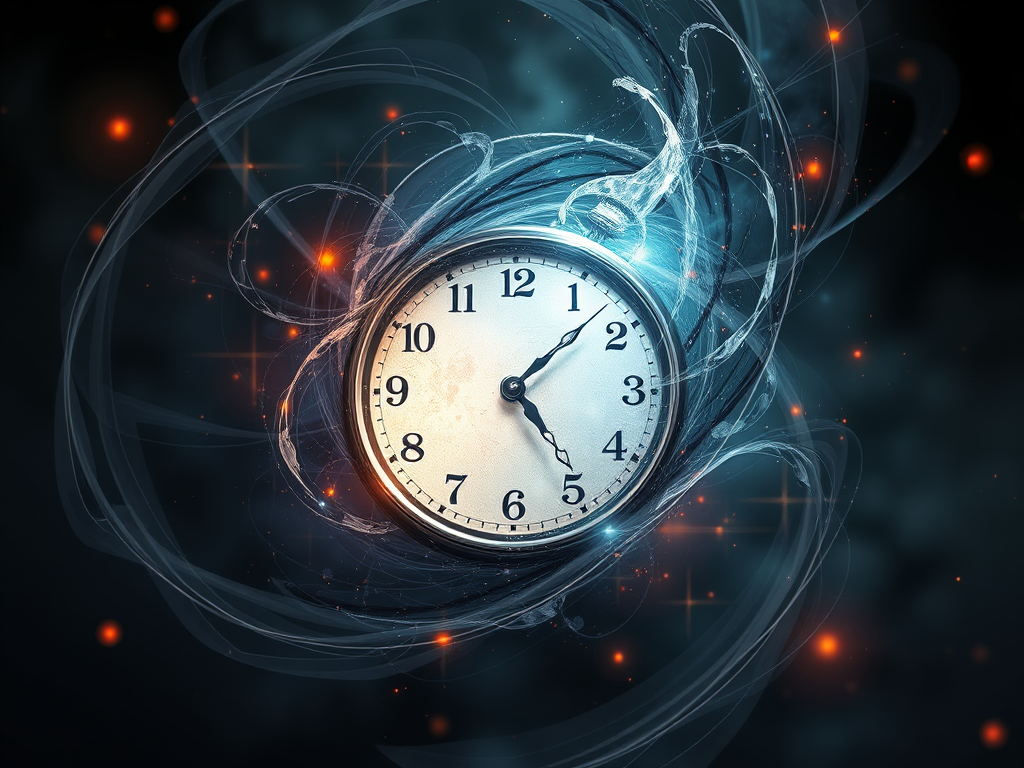
But here’s the deeper twist: Photons don’t experience time the way we do.
From their perspective, the moment they leave a star and the moment they hit your eye… is the same moment.
So that starlight you see at night — from a galaxy thousands of light-years away?
To that photon, it wasn’t a long journey. It was instant. Like teleportation.
Final thoughts
Light is the most basic thing we experience every day — and also the most science-fiction-sounding real thing in existence.
It’s made of magic packets of energy that behave like particles and ripples. It reshapes itself depending on whether you’re watching. And it doesn’t experience time at all.
So next time you watch a candle flicker — or even just turn on a lamp — pause for a second.
You’re not just lighting up the room. You’re witnessing quantum chaos, cosmic travel, and the raw material of reality — all riding on beams of light.







Leave a Reply