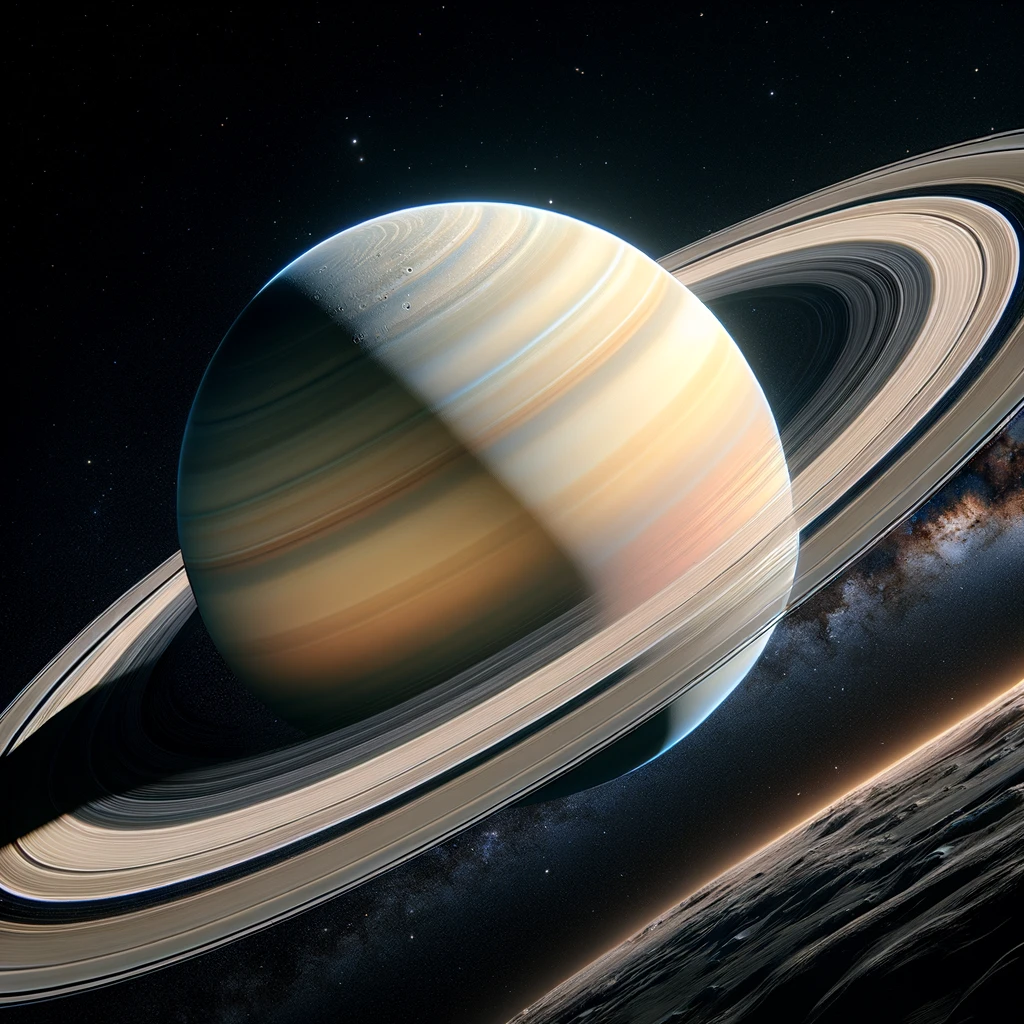
Yes, you read that right! Our solar system has its very own “Death Star,” and it’s not just a figment of sci-fi imagination. The moon in question is Mimas, one of Saturn’s many moons, and its uncanny resemblance to the iconic Death Star from “Star Wars” is truly striking. Now this moon is set to have a ocean buried underneath it’s surface.
But before that let’s dive into how did this celestial body come to look like a giant space station equipped with a planet-destroying superlaser?
A Crater That Steals the Show
Mimas has a huge crater named Herschel, which takes over most of its surface and gives it that distinctive Death Star appearance. This crater is about 130 kilometers wide—that’s close to one-third of the moon’s entire diameter—and it features a central peak that rises about 6 kilometers above the crater floor. The impact that created Herschel crater was so powerful that it nearly shattered Mimas. Ofcourse, if the impact had been any more forceful, it might have broken the moon apart.
Cassini’s Grand Finale Unveils Secrets
The now-defunct Cassini spacecraft, which explored Saturn and its moons for over 13 years, played an important role in uncovering the secrets of Mimas. Cassini ended its mission in 2017 when it plunged into Saturn’s atmosphere, a planned crash. But, before its grand finale, Cassini gathered vast amounts of data, including crucial insights about Mimas.
From the detailed analysis of this data, scientists recently made a groundbreaking discovery: beneath its icy shell, Mimas might be hiding a global ocean.

Not So Deep: Mimas’ Hidden Ocean
It seems that Mimas exhibits what are known as wobbling movements, thanks to the gravitational pull of Saturn, the same effect that’s responsible for tides on Earth.
These subtle motions hinted at something profound: a hidden, liquid layer beneath the icy exterior. This ocean is not buried too deep, lying just about 20 to 30 kilometers beneath the surface, followed by a thicker layer of ice.
This was a complete unexpected discovery. The icy shell appearance of Mimas suggests that the ocean is relatively young, estimated to be between 5 and 15 million years old. This timing is fascinating because it suggests that the moon’s interior hasn’t had enough time to react visibly to the ocean’s formation—there are no large cracks or other typical features associated with subsurface oceans.
What difference does it make?
We have one more place in the solar system to look for extraterrestrial life or even possible future space colonization. It proudly joins the ranks of celestial bodies like Europa and Enceladus, where internal oceans suggest the tantalizing possibility of life-friendly environments.
While Mimas’ stark, cratered appearance makes it look like a cold, dead world, beneath its surface, there could be processes that hint at the ingredients necessary for life. This makes Mimas a prime candidate for future missions that could explore these hidden depths more closely.
This discovery not just adds another one is the arsenal but also helps us understand more about our own solar system.
Now to wrap this up, the next time you look up at the night sky, remember that our solar system’s very own Death Star might be harboring secrets beneath its battle-scarred exterior.







Leave a Reply