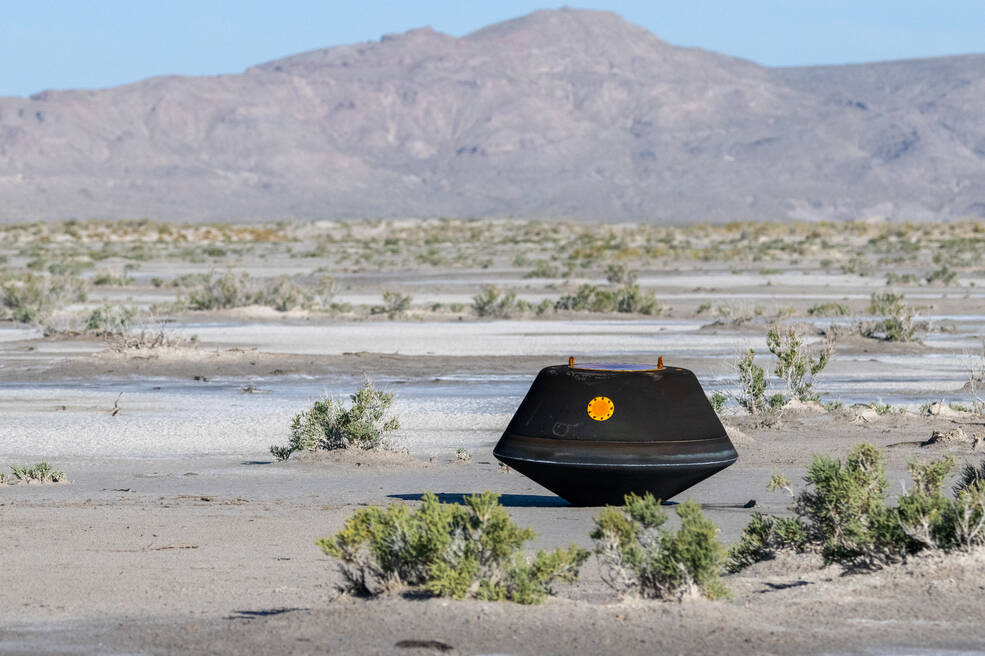
Ever since Bennu’s historic touchdown in the desert on Sunday, September 24, 2023, when the sample return capsule from NASA’s OSIRIS-REx, is not just a container; it’s a time capsule from the dawn of the solar system, holding roughly 4.5 billion-year-old rocks and primordial elements believed to have sparked life on Earth. It has emerged as a beacon of hope, leaving us to wonder that the universe might be more interconnected and alive than we ever imagined.
Bennu is not just a regular space rock; it’s a cosmic treasure chest brimming with secrets about the universe and possibly the origins of life itself.
Bennu Unveils Its Mineral Riches
Imagine finding a rare gem in your backyard. That’s exactly how scientists felt when they discovered a surprising reservoir of a mineral called magnesium phosphate in the samples collected from Bennu. This mineral is so rare in astromaterials that it left scientists scratching their heads because there are no good chemical analogues of it on Earth. But why is this important? The presence of magnesium phosphate in Bennu’s sample offers a unique window into different episodes of geologic activity that occurred on Bennu’s parent body, shedding light on the asteroid’s tumultuous past.
The Simplest Amino Acid with Huge Implications
Hold onto your hats because Bennu’s surprises don’t stop there. The samples also revealed the widespread presence of glycine, the simplest amino acid and a crucial building block of proteins. Finding glycine in Bennu is like discovering a universal recipe for life scattered throughout the cosmos. It hints at the intriguing possibility that the ingredients for life are not exclusive to Earth but are instead woven into the very fabric of the universe.
Credit: NASA
A Cocktail of Life-Sustaining Minerals
And there’s more. Alongside glycine, scientists discovered a variety of water-bearing minerals including carbonates, sulfites, olivine, and magnetite. These findings are like pieces of a cosmic puzzle, indicating that Bennu’s parent body witnessed multiple water-related episodes before its fragments coalesced into the asteroid we know today. Water is the elixir of life, and the presence of these minerals further supports the idea that the building blocks of life might be more common in the universe than previously thought.
The Cradles of Life in the Cosmos
The extraterrestrial bounty didn’t end with amino acids and water-bearing minerals. Scientists found abundant water-altered compounds called phyllosilicates, along with a rich collection of other organic and hydrated minerals. Phyllosilicates are especially fascinating because they are thought to be the cradles for organics and water, possibly playing a pivotal role in delivering the ingredients for life to Earth early in its history.
As we continue to decode the secrets hidden within these precious samples, we edge closer to answering one of humanity’s most profound questions: Are we alone in the universe? Stay tuned, because the journey through space, time, and the origins of life is just getting started, and it promises to be a thrilling ride!







Leave a Reply