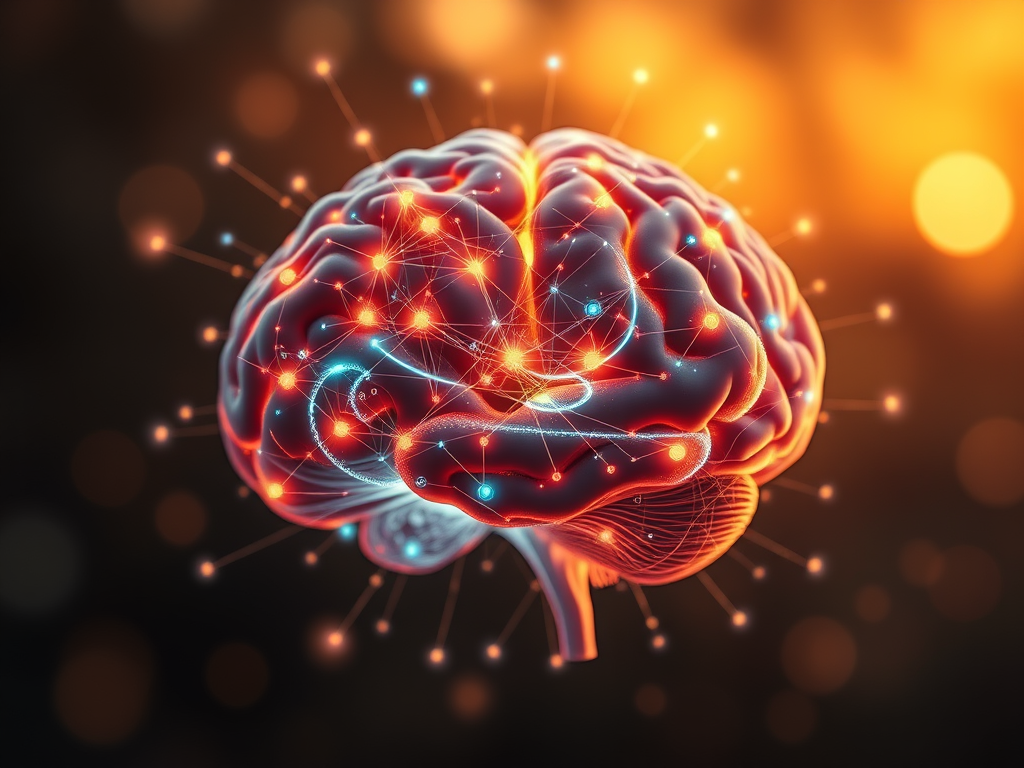
We’ve all had at least one moment in life where we’ve felt it—that subtle sense that there’s more happening beneath the surface than what you see.
A sunset.
A concert.
A quiet pause that feels strangely loud.
That connection you’ve felt? That’s what I’m here to explore. Specifically: what’s happening in your brain during moments like that?
Yes, the emotions you experience are the result of chemical and electrical signals firing in complex neural patterns. That’s the story we’re used to hearing.
But what if I told you that consciousness might run deeper than those signals in your brain?
What if we’re only beginning to have the scientific language to describe it?
And what if the answers lie not in turning away from physics, but by going deeper into it?
Quantum Mechanics Is Not Philosophy—It’s the Code Everything Runs On
Life started simple – single celled organisms in a chaotic soup of chemistry. But over time, evolution did something more: It didn’t just adapt to its environment, it began to harness the laws that built the universe.
Let’s talk quantum biology—a field exploring how living organisms, down to the molecular level, may be using quantum phenomena to survive, evolve, and function in ways we’re only beginning to understand.
- Cells learned to use quantum tunneling to speed up chemical reactions (enzymes).
- Plants figured out quantum coherence to move energy efficiently (photosynthesis).
- Birds evolved to use quantum entanglement to navigate across continents.
These aren’t metaphors. They’re real, quantum effects, leveraged by biological evolution.
All of this traces back to the same single-celled ancestor that gave rise to the human nervous system. So let’s ask the obvious question:
Why wouldn’t the brain—the most energy-hungry, finely-tuned, evolutionarily optimized structure in the known universe—be doing the same?
It wouldn’t just make sense.
It would be weird if it didn’t.
And not in a mystical, sci-fi kind of way. In a real, testable, physics kind of way.
What Might Quantum Processes Be Doing in the Brain?
If tunneling helps enzymes react,
If coherence helps plants harvest light,
If entanglement helps birds find their way home…
Which brings us to the next obvious thought:
What might these same phenomena be doing in your mind?
In your memory?
In your consciousness?
Maybe consciousness is not just a byproduct of the brain. Maybe the brain is a receiver, a resonator, or even an interface to a field we haven’t fully mapped yet.
This doesn’t mean consciousness is supernatural. It might just mean, it’s more fundamental than we thought.
Quantum Field Theory Says…
In physics, all particles and forces emerge from fields—vibrating, interacting structures that span all of spacetime.
If consciousness is somehow field-related, then maybe the brain isn’t just processing electrical inputs and outputs.
Maybe it’s tapping into something bigger—something nonlocal, continuous, and fundamentally real.
This Isn’t About Mysticism. It’s About Better Questions.
Science doesn’t need to strip the wonder out of life. It can illuminate it.
If quantum behavior shapes metabolism… If it powers photosynthesis through coherence… If it guides birds using entanglement…
Why wouldn’t it shape your brain? Your thoughts? Your consciousness?
Maybe evolution didn’t just build brains to calculate and survive. Maybe evolution was the universe’s way of building a structure complex enough to experience itself.
This isn’t spiritual talk. It’s science.
Not physics versus biology.
Not classical versus quantum.
But both—working together, as they always have.
And that quiet feeling you’ve always had—that there’s something deeper, something more?
Maybe that’s not your imagination. Maybe that’s physics.
Epilogue: The Conversation Is Just Beginning
Quantum biology is still emerging—but it’s already challenging what we thought we knew about life.
From coherence in photosynthesis to tunneling in enzymes, to entanglement in avian brains—the evidence is growing.
Now researchers are asking the next big question:
Could quantum effects play a role in consciousness?
Books like Life on the Edge by Jim Al-Khalili and Johnjoe McFadden, or The Emperor’s New Mind by Roger Penrose, explore these ideas in depth. New experiments in physics and neuroscience are starting to test them.
This isn’t science fiction. It’s the frontier of science itself.
And if it turns out to be true?
It could change not just how we understand the universe— But how we understand ourselves.








Leave a Reply