Okay, let’s talk about one of the most mind-bending moments in space history—the Wow! signal. If you’ve never heard of it, you’re in for a treat! Back in 1977, a radio telescope known as Big Ear picked up a powerful, narrowband radio signal from deep space. It was so out of the ordinary that astronomer Jerry Ehman circled the printout and scribbled “Wow!” next to it, giving the signal its now-iconic name.
For decades, the Wow! signal was like the holy grail for alien hunters. It came from the direction of the constellation Sagittarius, at a frequency (1,420 MHz) associated with hydrogen, the most abundant element in the universe. To many, it was the perfect candidate for an interstellar “hello” from another civilization. But here’s the thing—no one ever detected it again.
It was a one time event – Nothing. Nada. Zilch.
So, what gives? Was it aliens? Or just some kind of weird space noise?

Enter, the new hypothesis:
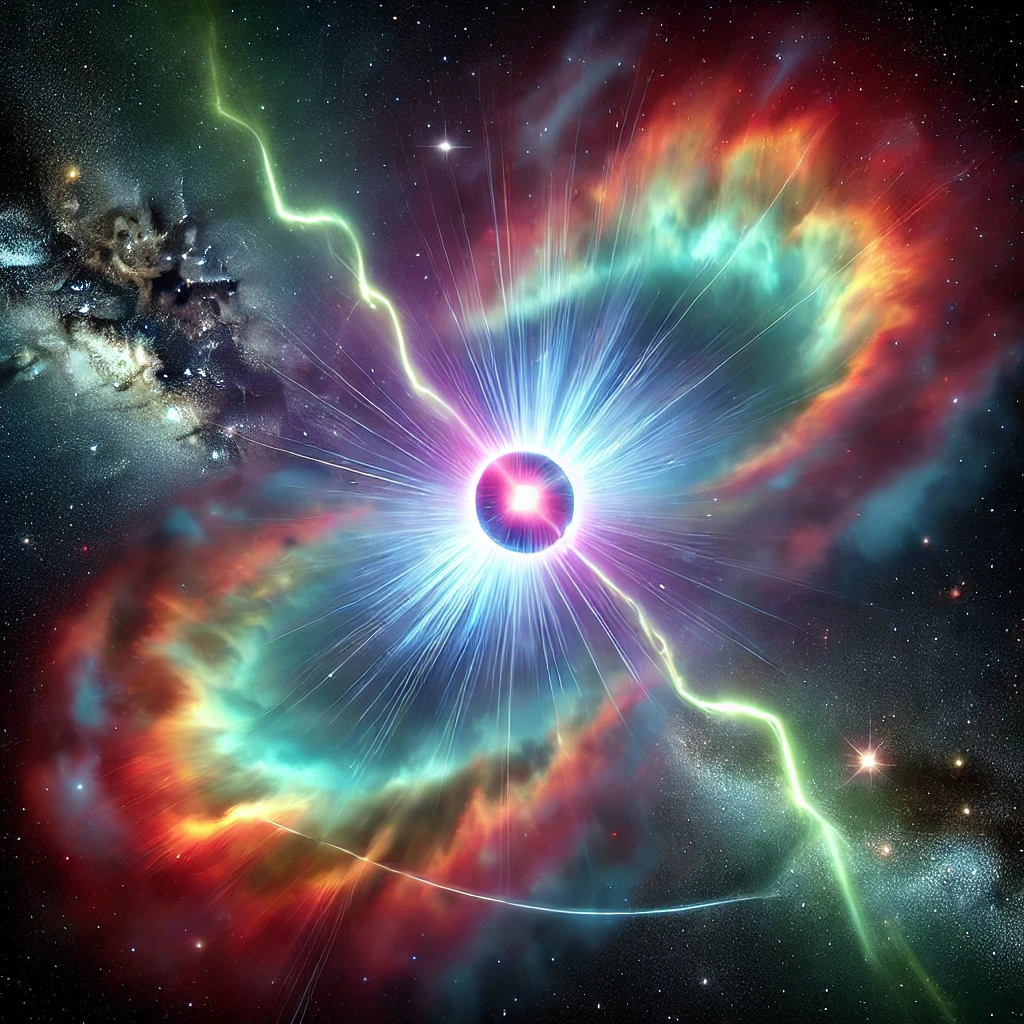
A fresh explanation has come onto the scene that could put the alien theory to rest. According to recent research led by planetary astrobiologist Abel Méndez and his team, the Wow! signal might not have been a message from little green men, but rather a rare cosmic phenomenon involving a magnetar—which, to put it simply, is a super-intense, highly magnetized neutron star.
Here is what happened, A magnetar flares up, sending out a burst of radiation. That radiation then slams into a cloud of hydrogen, causing it to glow in a way that’s detectable by radio telescopes. Voilà, you get a signal just like the Wow! signal! Sounds pretty wild, right?
The key here is the rarity. Magnetars are already rare, and the perfect conditions—where the magnetar’s radiation aligns just right with Earth and a hydrogen cloud—are even more unusual. This could explain why we haven’t seen the Wow! signal (or anything like it) again. It was a one-in-a-million alignment
Everyone may not be convinced:
Of course, not everyone’s ready to close the book on aliens. Some astronomers think this magnetar hypothesis, while interesting, might be a bit of a stretch. After all, the conditions would have to be incredibly precise for this to work. Plus, signals like this haven’t been observed in other similar cosmic events. As one critic pointed out, it’s possible, but “highly specific” doesn’t exactly mean “case closed”
In the past, some have speculated that the Wow! signal could’ve been caused by something closer to home—like a stray Earth-based signal bouncing off space debris. But this theory has some problems, too. For one, the signal didn’t show up in both of Big Ear’s receivers, which you’d expect from a terrestrial reflection. Plus, follow-up observations came up empty.
So, Where Does That Leave Us?
The magnetar explanation is certainly intriguing, but we’re still left with a lot of questions. The Wow! signal remains one of those fascinating space mysteries that keeps scientists and space enthusiasts alike captivated. Even if it turns out to be a cosmic coincidence, the fact that we could detect such an event is pretty incredible on its own.
And hey, if you’re still holding out hope for aliens—don’t worry. The search is far from over, and who knows what other cosmic surprises are waiting to be discovered? For now, the Wow! signal will remain one of the greatest mysteries in our quest to understand the universe.
So, what do you think? Was it aliens, or just some stellar science at work? Keep your ears (and telescopes) open—you never know what we’ll pick up next!







Leave a Reply