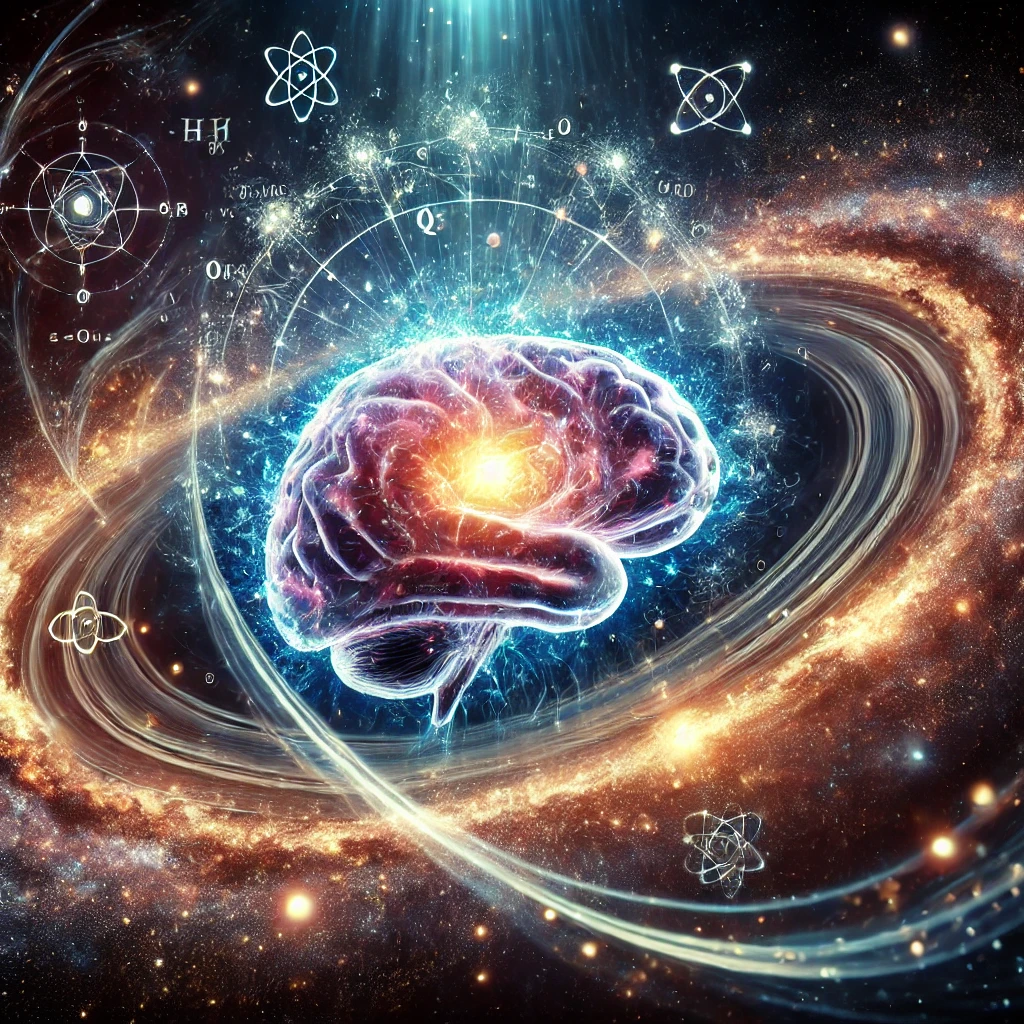
Connecting the Cosmos, Consciousness, and Cycles
Atoms, the building blocks of matter, are made of stardust—remnants of ancient stars that exploded and scattered their elements across the cosmos. Yet, this stardust, the very substance that makes up everything we see and touch including our very own being, represents only a small fraction of the universe. In fact, all the atoms and ordinary matter we know account for just about 5% of the universe’s total content. The rest is dominated by the enigmatic forces of dark matter and dark energy, which together shape the cosmos in ways we are only beginning to understand.

But what about the mysteries within us? Consciousness, the very phenomenon that allows us to think, perceive, and wonder about the universe, might also be a crucial piece of this cosmic puzzle.
Could the same principles that govern the vast, complex universe also explain the emergence and evolution of consciousness? This question lies at the heart of the quest for a Unified Theory of Everything.
The Cosmic Puzzle

Dark energy, which makes up nearly 70% of the universe, drives its accelerated expansion, while dark matter, constituting about 27%, exerts gravitational forces that hold galaxies together. As beings made of atoms, we are a part of this vast, mysterious universe—perhaps more deeply connected to its fundamental nature than we realize.
One intriguing possibility is that we, both physically and consciously, are not just passive inhabitants of the universe but active participants in its ongoing evolution. This idea ties into the concept of a cyclic universe—a universe that undergoes endless cycles of birth, death, and rebirth.
Cyclic Universe: A Scientific Perspective

The idea of a cyclic universe is supported by theories such as Conformal Cyclic Cosmology (CCC), proposed by Sir Roger Penrose. According to CCC, the universe goes through infinite cycles of expansion and contraction. Each cycle, or “aeon,” begins with a Big Bang and ends in a state so smooth and empty that it resembles the conditions at the beginning of the next cycle. In this way, the universe could be eternal, with each cycle giving rise to new forms of matter, energy, and possibly even consciousness.
If we are indeed part of a cyclic universe, then it is possible that consciousness itself evolves and persists through these cosmic cycles. Just as matter and energy are conserved and transformed, consciousness might be a recurring phenomenon, evolving alongside the universe’s physical components.
Consciousness: The Ultimate Learner
To understand how consciousness might fit into this grand cosmic cycle, consider how AI works today. Modern AI systems learn by processing vast amounts of data, gradually improving their understanding and capabilities through experience and computation. Over time, AI becomes more adept at recognizing patterns, making decisions, and even creating new ideas.

Now, imagine if human consciousness evolved in a similar way—not through artificial means, but through the gradual accumulation and processing of information across generations. Since the dawn of civilization, humans have been learning, storing, and passing down knowledge. This continuous accumulation of knowledge and experience could be seen as a process of “learning” on a cosmic scale.
Just as AI becomes more sophisticated through data and learning, human consciousness have been evolving by integrating information from the natural world, ancient civilizations, and the collective human experience. Over millennia, this learning process have been shaping the development of our consciousness, allowing us to think, perceive, and understand the universe in increasingly complex ways.
Connecting the Dots
A Unified Theory of Everything seeks to connect all these elements—atoms, dark energy, the cycles of the universe, and consciousness—into a single, coherent framework. The idea is that the principles governing the cosmos at its largest scales might also apply to the emergence and evolution of consciousness.
Existing Theories and Consciousness:
- String Theory:String Theory is one prominent approach that seeks to unify the fundamental forces of nature—gravity, electromagnetism, and the nuclear forces—by positing that all particles are made of tiny, vibrating strings. However, while String Theory provides a mathematical framework for unifying physical forces, it traditionally does not account for consciousness.
- Quantum Mechanics:Quantum Mechanics, which deals with the behavior of particles at the smallest scales, might offer insights into consciousness. The Orchestrated Objective Reduction (Orch-OR) theory, proposed by Roger Penrose and Stuart Hameroff, suggests that consciousness arises from quantum processes within the brain’s microtubules. If quantum effects are indeed involved in consciousness, then the same quantum principles that shape the cosmos could also be at work within us.
- Conformal Cyclic Cosmology (CCC):In contrast, Conformal Cyclic Cosmology (CCC) offers a broader perspective by suggesting that the universe undergoes endless cycles of rebirth. If consciousness can re-emerge in different forms with each new cosmic cycle, this would suggest a deep, intrinsic connection between the universe’s physical processes and the evolution of consciousness.
This leads to a profound and potentially unifying idea: that consciousness and the universe are not separate entities, but different expressions of the same underlying reality. Just as the physical universe evolves through cycles, so too might consciousness evolve, adapt, and persist through these cosmic cycles. This perspective challenges us to consider consciousness as an integral part of the universe, shaped by the same quantum and cosmological principles that govern the behavior of galaxies and particles alike.
Toward a Deeper Understanding
The quest for a Unified Theory of Everything is not merely a search for a set of equations that describe the physical universe; it is a journey toward understanding the deepest connections between the cosmos and consciousness.

Comparing the various existing theories—String Theory, Quantum Mechanics, and Conformal Cyclic Cosmology—highlights the challenges and possibilities in developing a unified theory that includes consciousness. String Theory offers a framework for unifying physical forces, while Quantum Mechanics provides potential insights into the quantum nature of consciousness. Meanwhile, Conformal Cyclic Cosmology opens the door to viewing consciousness as a recurring phenomenon within the eternal cycles of the universe.
By integrating these perspectives, we might move closer to a unified theory that not only explains the physical laws of the universe but also encompasses the conscious experiences that arise within it.






Leave a Reply