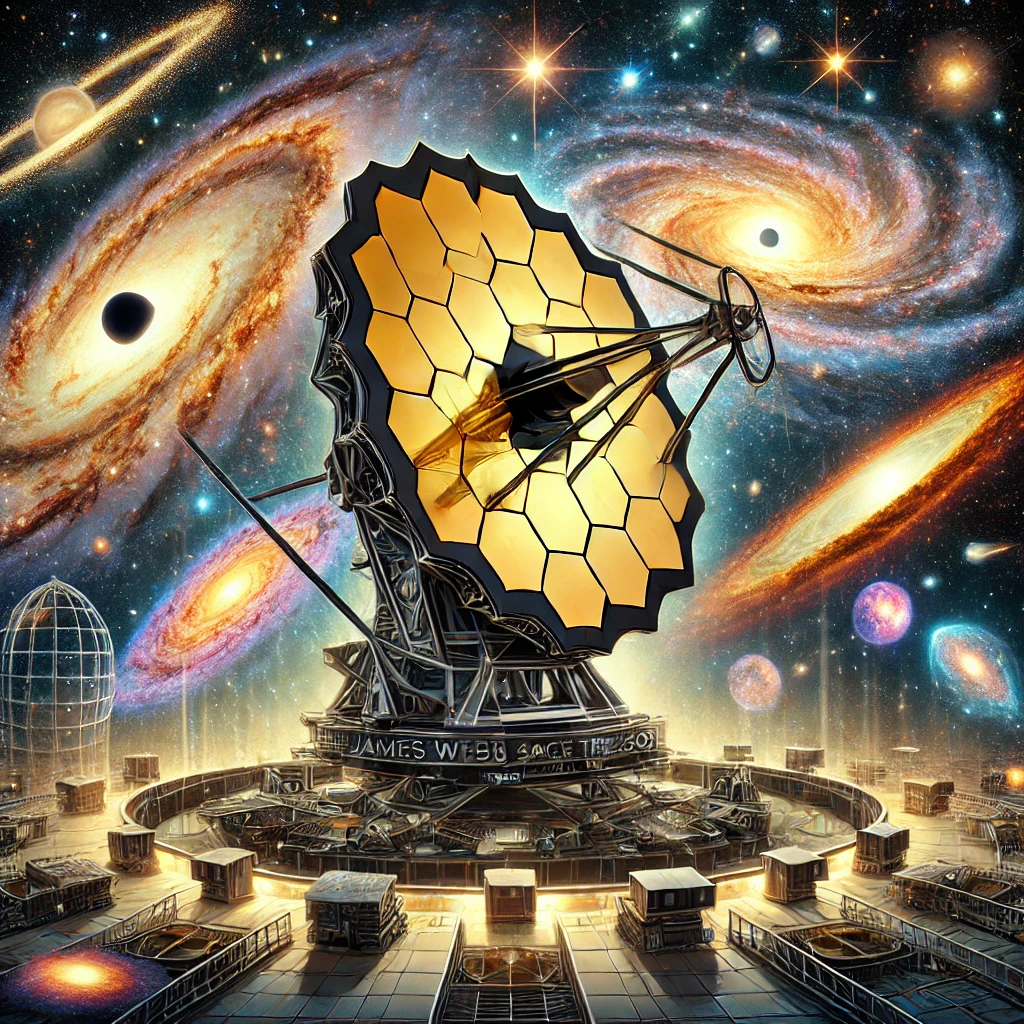
The universe is packed with mysteries, and we’ve just started to unravel its secrets. Enter the James Webb Space Telescope (JWST), our ultimate cosmic sleuth! Since its launch, JWST has been our most powerful eye in the sky, revolutionizing our understanding of the cosmos with every new discovery.
Let’s dive into the mind-blowing findings that JWST has brought us!
1. Early Universe’s Carbon-Rich Dust

- What: JWST’s Near Infrared Spectrograph (NIRSpec) detected carbon in a galaxy from 350 million years after the Big Bang. The carbon includes polycyclic aromatic hydrocarbons (PAHs), complex organic molecules essential for life.
- What It Suggests: This means the building blocks of life formed much earlier in the universe’s history than we thought, possibly allowing life to emerge sooner.
- Challenge: This shakes up our timeline for life-essential elements, hinting that life could have had a head start!
2. Massive Galaxies in the Infant Universe

- What: JWST spotted galaxies as massive as the Milky Way, existing just 500 to 700 million years after the Big Bang. These galaxies are unexpectedly large and mature, with old, red stars.
- What It Suggests: Galaxies might form and mature much faster than we imagined.
- Challenge: This discovery could force us to rewrite our models of early galaxy formation and understand how they grew so quickly.
3. Pristine Gas Clumps and Population III Stars

- What: Using NIRSpec, JWST found a clump of helium gas in the halo of the galaxy GN-z11, indicating a pristine composition. This clump likely contains material unprocessed by previous star generations, pointing to Population III stars.
- What It Suggests: This backs the existence of the first generation of stars, composed almost entirely of hydrogen and helium.
- Challenge: Understanding these stars is crucial for our models of early star and galaxy formation, marking a shift from a simple to a complex universe.
4. First Supermassive Black Holes

- What: JWST’s NIRCam and NIRSpec detected signs of supermassive black holes in early galaxies by spotting dense gas and high-velocity winds. These black holes formed and grew rapidly in the early universe.
- What It Suggests: Black hole formation and growth processes might be more efficient than we thought.
- Challenge: This could lead to new theories on how supermassive black holes form and affect galaxy evolution from the very start.
5. Complex Organic Molecules

- What: JWST detected spectral signatures of complex organic molecules in a galaxy over 12 billion years old. These molecules, similar to those in oil and coal on Earth, are linked to dust grains.
- What It Suggests: Complex chemical processes were happening very early in the universe’s history.
- Challenge: This suggests that life-essential chemistry existed much earlier, influencing our models of chemical evolution in galaxies.
6. Phantom Galaxy’s Dusty Structures

- What: JWST’s imaging revealed detailed structures of heat-emitting dust and gas in the Phantom Galaxy (NGC 628). These intricate, fiber-like structures highlight star-forming regions.
- What It Suggests: Detailed observations help pinpoint where and how stars form within galaxies.
- Challenge: This enhances our understanding of star formation and the role of interstellar dust in galaxy evolution.
7. Debate Over the Universe’s Expansion Rate
- What: JWST observed Cepheid variables, which help measure cosmic distances and estimate the universe’s expansion rate. Observations revealed discrepancies in the Hubble constant measurements, deepening the debate.
- What It Suggests: These findings highlight inconsistencies in our understanding of the universe’s expansion.
- Challenge: This could lead to new models or adjustments to resolve these discrepancies and better understand the universe’s expansion dynamics.
8. Wolf-Rayet Star’s Mysterious Rings

- What: JWST imaged the Wolf-Rayet star WR140, revealing concentric rings of dust with a peculiar shape. These rings are formed by the interaction between WR140 and its companion star.
- What It Suggests: The observations provide insights into the late stages of stellar evolution and the formation of dust in massive star systems.
- Challenge: This enhances our understanding of how massive stars evolve and contribute to the dust content in the universe, crucial for new star and planet formation.
JWST’s discoveries are not just about seeing farther into space; they’re about rewriting the textbooks and expanding our cosmic knowledge. Stay tuned as this incredible telescope continues to unveil the mysteries of the universe!







Leave a Reply