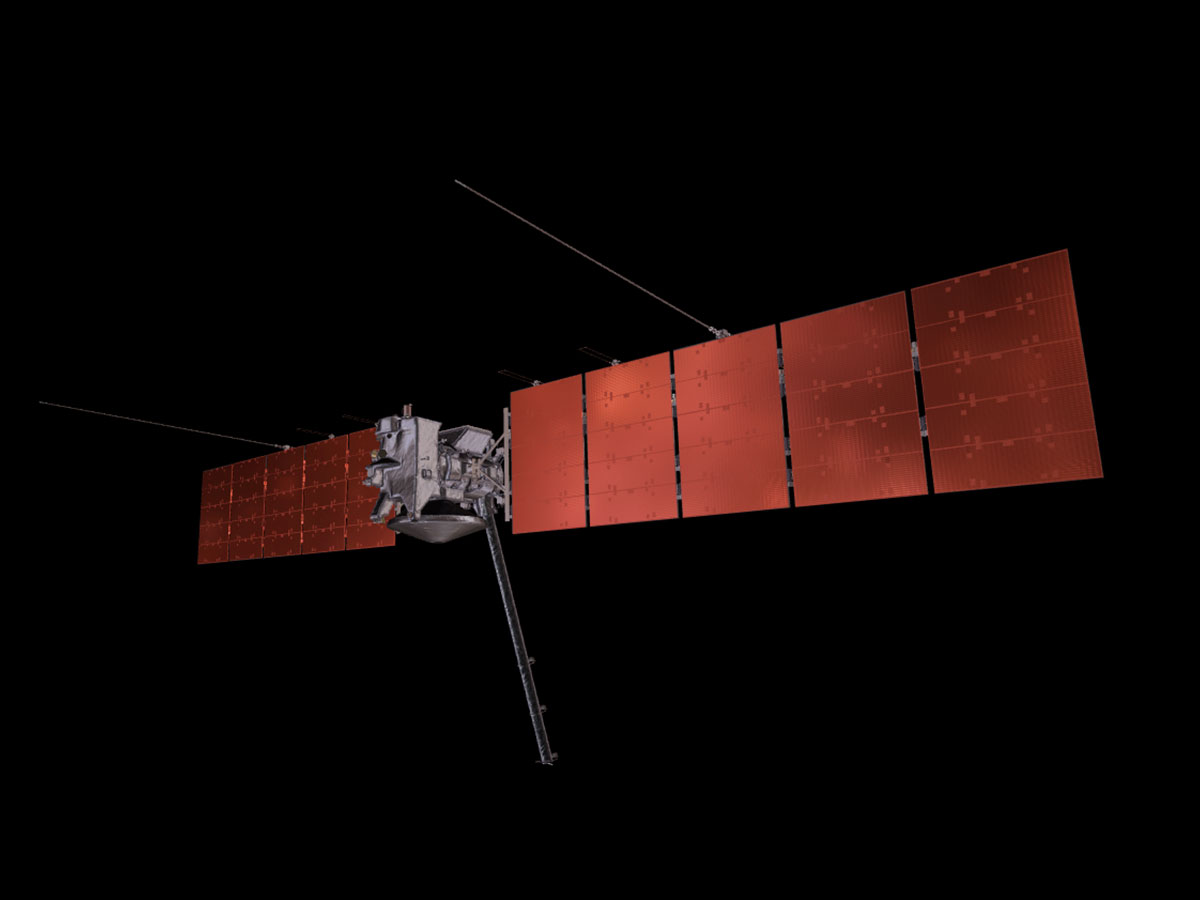
In the depths of the enigmatic cosmos, a groundbreaking endeavor is underway. NASA’s ambitious mission to the distant, frozen moon of Jupiter, Europa, holds within it a profound message from humanity, echoing our relentless pursuit to comprehend the mysteries of the universe. This extraordinary journey signifies a remarkable juncture in our collective endeavor to fathom our cosmic existence.
The Stellar Story
In the quest to explore the mysteries of space, the Europa Clipper carries with it a profound symbol of humanity’s unyielding fascination with the cosmos.
Spacecraft Type: Orbiter
Launch Window Opens: October 10, 2024
Science Instruments: 9
Science Target: Europa
Jupiter Orbit Insertion: April 2030
Europa Clipper’s goal is to determine whether there are places below the surface of Jupiter’s icy moon, Europa, that could support life. This mission will help the scientists understand the nature of the ice shell and the ocean beneath it, along with the moon’s composition and geology as well as grasp the astrobiological potential for habitable worlds beyond our planet.
Say hello to Clipper:
NASA’s Europa Clipper mission is set to embark on an extraordinary voyage of discovery, executing nearly 50 precision flybys of Jupiter’s enigmatic moon, Europa. Orbiting Jupiter, the spacecraft will dip to within just 16 miles (25 kilometers) of Europa’s surface. Each flyby will chart a unique course, allowing the spacecraft to sweep over diverse regions and compile comprehensive measurements that promise to unveil the secrets of this icy world.
The Discovery Journey
The mission is focused on searching for life beyond Earth. Europa has strong evidence of an ocean of liquid water beneath its icy crust. It is considered a great candidate for searching for habitable environments nearby. The Europa Clipper mission aims to determine if there are places below Europa’s surface that could support life.
The spacecraft’s payload will include cameras, spectrometers, and a radar to study Europa’s surface, atmosphere, and subsurface water. It will also carry instruments to measure the composition of particles in the moon’s atmosphere and surrounding space environment. The mission aims to unlock clues about Europa’s ocean and deep interior through magnetometer and gravity measurements. Furthermore, a thermal instrument will pinpoint warmer ice locations and potential recent water eruptions. Overall, the spacecraft’s comprehensive instruments will provide valuable insights into Europa’s composition and environment.
Cosmic Postcard
The Europa Clipper’s cargo is a testament to humanity’s enduring desire to reach out and touch the universe.
- The Europa Clipper will carry a microchip, no larger than a dime, will be the centerpiece of an illustration of a bottle amid the Jovian system – a reference to NASA’s “Message in a Bottle” campaign with over 2.6 million names.
- A triangular metal plate on the spacecraft will honor that connection to Earth in several ways.
- At the heart of it is etched with a poem by U.S. Poet Laureate Ada Limón’s handwritten “In Praise of Mystery: A Poem for Europa,”.
- The Drake Equation as a tribute to the visionary idea that the probability of finding life in the cosmos is something we can estimate.
- “Water Hole” Radio Emission Lines which represents a connection between water and the search for life beyond Earth. They are also a scientific and mathematical way of expressing the word “water” — the chemical symbols for hydrogen and hydroxyl, H and OH, represent the products when water molecules (H2O) are split apart.
- Tribute to Planetary Scientist Ron Greeley
- The cargo also represents humanity’s enduring desire to explore and connect with the universe.
- The metal canvas adorned with resonating art carries our collective voice into the unknown.
Brains Behind the Cosmos
Europa Clipper’s scientists and engineers include not just a few but many brilliant mind in the field of planetary exploration. Some came from leading roles in the flyby of Pluto by NASA’s New Horizons mission. Several have worked together for decades, exploring Europa and other icy moons with NASA’s Cassini, Galileo, and Voyager missions.
Take a look at the full team members here.
Visual Voyage

“The Drake Equation”

“Planetary Scientist Ron Greeley”

“The Poem”
Did You Know? – Fun Facts
- Europa’s ocean holds twice the volume of Earth’s combined seas, concealed beneath an icy facade.
- The word “water” has been sent to Europa in 103 languages, captured in waveforms on the plate.
What are your thoughts on this interstellar message? Let’s continue the cosmic conversation in the comments below.
Together, we can spread the word about our cosmic journey and share more celestial tales. Don’t forget to hit subscribe and journey with me and other cosmic aficionados. Keep looking up!







Leave a Reply